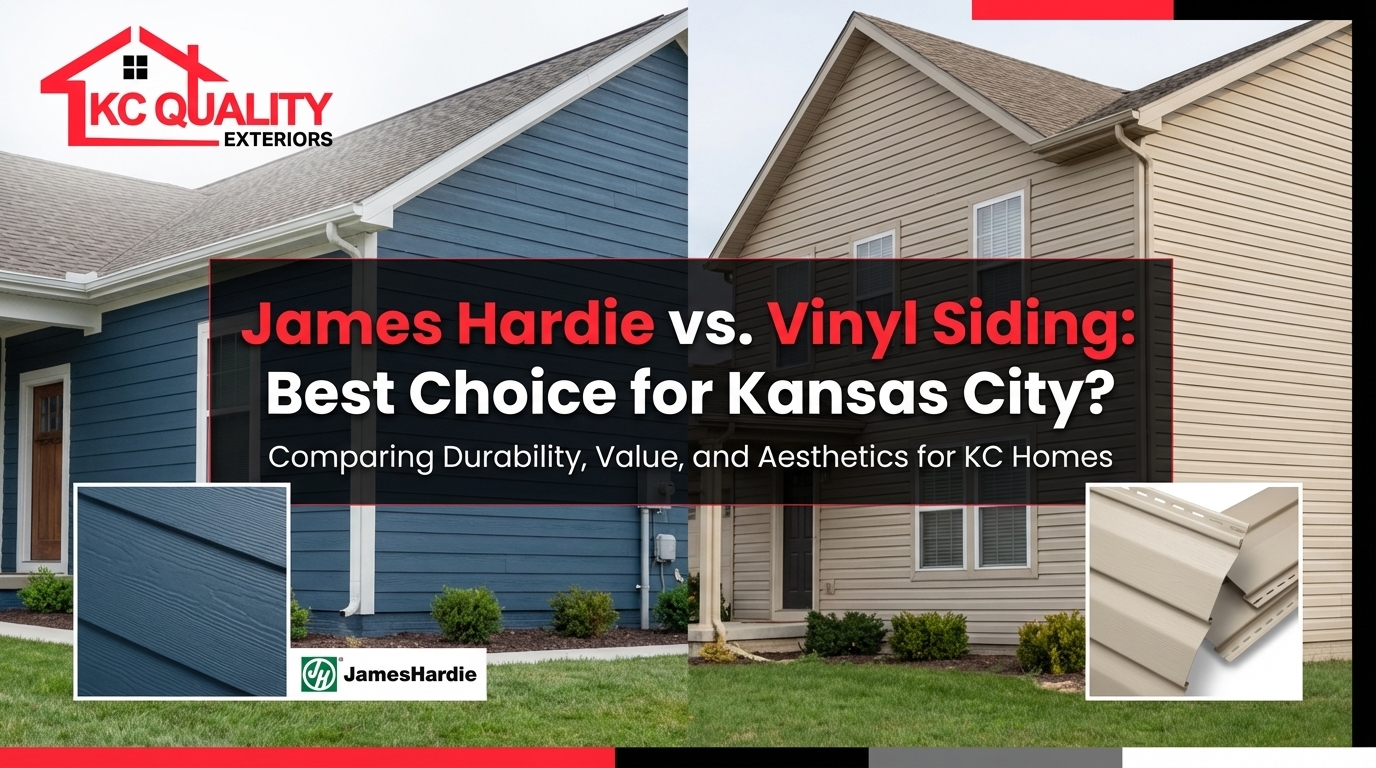
James Hardie vs. Vinyl Siding: Best Choice for Kansas City?
James Hardie vs. Vinyl Siding: Which is the Best Choice for Your Kansas City Home?
Choosing the right siding for your home in the Kansas City metro is a high-stakes decision that impacts your property's value, protection, and curb appeal for the next 30 years. Our local climate is notoriously volatile, swinging from sub-zero winter blasts to 100-degree humid summers, often punctuated by the occasional spring hail storm. In this environment, your siding isn't just a decorative shell; it is the primary defense system for your home's structural integrity. At KC Quality Exteriors, we believe in a "heart of a teacher" approach, providing you with the transparency you need to decide between the two industry titans: James Hardie Fiber Cement and Traditional Vinyl Siding.
The Quick Answer: For most Kansas City homeowners, James Hardie Fiber Cement is the superior choice for long-term ROI, hail resistance, and neighborhood aesthetics. However, high-quality vinyl siding remains a viable, budget-friendly option for those looking for immediate cost savings or short-term property flips where high-end durability is less of a priority.
1. The High-Stakes Choice for Kansas City Exteriors
In the Midwest, your home's exterior faces a unique set of challenges that coastal or southern homes rarely encounter. We deal with the "freeze-thaw cycle"—a phenomenon where moisture enters small cracks, freezes, expands, and then melts, causing materials like wood and low-grade vinyl to warp, crack, or rot. This makes the material composition of your siding choice critical to your home's longevity.
When homeowners in Overland Park, Lee’s Summit, or the Northland call us for an estimate, they are usually at a crossroads. They are tired of painting old wood siding or are dealing with cracked, faded vinyl from a previous decade. They want a solution that won't require another full replacement in ten years. This guide is designed to break down the technical differences, local financial incentives, and aesthetic considerations specific to the Kansas City market.
The Impact of Local Trends
Over the last decade, we have seen a massive shift in the KC metro toward fiber cement products. This is largely driven by neighborhood associations (HOAs) and the increasing frequency of severe weather events. Understanding why James Hardie has become the "gold standard" requires looking beyond the price tag and into the physical science of the materials themselves.
2. At a Glance: James Hardie (Fiber Cement) vs. Traditional Vinyl
To understand the comparison, we must first look at what these products are actually made of. James Hardie is a fiber cement product, a composite material made of Portland cement, sand, and cellulose fibers. This results in a heavy, masonry-like board that mimics the look of real wood without the vulnerability to moisture and pests.
Vinyl siding, on the other hand, is made primarily of PVC (polyvinyl chloride). It is a type of plastic that is lightweight, flexible, and chemically engineered to resist rot. While modern vinyl technology has come a long way, it remains a fundamentally different product in terms of density and heat response compared to fiber cement.
Feature James Hardie Vinyl Siding Composition Cement, Sand, Cellulose PVC Plastic Thickness 5/16 inch (Thick & Sturdy) .040 - .046 inch (Thin) Fire Rating Non-Combustible (Class A) Melts in High Heat Expected Life 30-50 Years 20-30 Years
The Weight Factor
It is important to note that James Hardie is roughly five times heavier than vinyl. For many homes, this is a non-issue, but for older properties in Kansas City's historic districts, we always perform a foundation and wall-stud assessment to ensure the structure can handle the additional load of fiber cement. Vinyl, being lightweight, can be installed over almost any existing structure without concern for weight.
3. The Kansas City Weather Test: Hail, Humidity, and 100-Degree Swings
In Kansas City, hail isn't a matter of "if," but "when." When a storm rolls through Mission Hills or Liberty, the impact on your siding is immediate. Fiber cement is significantly more impact-resistant than vinyl. During a hail storm, vinyl siding often becomes brittle over time due to UV exposure; when hit by a hailstone, it can crack, shatter, or leave "starburst" fractures that compromise the water barrier.
James Hardie, because of its density, typically withstands hail impacts that would destroy vinyl. Furthermore, Hardie's HZ5® product line is specifically engineered for the Midwest (Zone 5). This means it is designed to resist the specific challenges of our climate, including moisture expansion and heavy snow loads that lean against the base of the home.
The 100-Degree Expansion Gap
Vinyl siding is designed to "float" on your house. It expands and contracts significantly as temperatures change. If an installer nails vinyl too tightly during a hot Kansas City August, it will buckle and warp when the temperature drops in January. James Hardie is dimensionally stable; it doesn't move nearly as much, allowing for tighter joints and a more permanent, high-end look that doesn't rattle in the high winds we see on the Kansas plains.
4. Curb Appeal & Neighborhood Standards: Fitting into Johnson County and Historic KC
Curb appeal in Kansas City is highly regional. If you live in a newer development in Olathe or Blue Springs, your HOA likely has strict guidelines regarding the types of materials allowed. Many modern HOAs are now requiring fiber cement on the front elevations at a minimum because vinyl is often perceived as a lower-tier material that can negatively affect neighborhood property values.
For those in historic districts like Hyde Park, Valentine, or the Westside, the choice is often made for you. These districts frequently ban vinyl siding entirely because it lacks the authentic "shadow lines" and texture of the original wood siding. James Hardie is one of the few modern materials that historic boards consistently approve because it can be milled to match historic profiles and can be painted any color to match the neighborhood's character.
ColorPlus® Technology vs. Vinyl Fading
James Hardie offers ColorPlus® Technology, which is a factory-applied, baked-on finish that resists UV fading better than traditional paint. Vinyl siding has the color baked all the way through the plastic, which sounds like an advantage, but over 10-15 years of Kansas City sun, the plastic can oxidize and fade. Once vinyl fades, you cannot easily repaint it to look like new, whereas Hardie can always be refreshed with a new coat of high-quality acrylic paint.
5. Maintenance Reality Check: What ‘Low Maintenance’ Actually Means in the Midwest
Both products are marketed as "low maintenance," but they require different types of care. Vinyl siding is arguably the lowest maintenance in terms of effort; it usually just requires a power wash once a year to remove dirt and algae. However, "low maintenance" doesn't mean "no repairs." If a lawnmower kicks a rock into your vinyl siding, you often have to replace an entire 12-foot panel because you can't simply "patch" plastic.
James Hardie requires slightly more proactive maintenance. You need to keep an eye on the caulk at the joints and ensure the paint remains in good condition. Typically, a Hardie home needs repainting every 15 years. The trade-off is that Hardie is incredibly durable against physical damage. It is also resistant to pests like woodpeckers, termites, and carpenter bees, which are a common headache for KC homeowners with wood or even some types of composite siding.
The Woodpecker Problem
In wooded areas of the Kansas City metro, such as Parkville or south Overland Park, woodpeckers can wreak havoc on cedar siding and even certain foam-backed vinyl products. They have no interest in James Hardie. Because it is essentially a thin sheet of concrete, birds cannot peck through it, and insects cannot nest inside it, saving you thousands in potential pest-remediation costs over the life of the home.
6. Financial Breakdown: Upfront Installation Costs vs. 30-Year ROI
The most common question we get is: "How much more does James Hardie cost?" On average, a James Hardie installation will cost 30% to 50% more than a standard vinyl installation. This is due to both the material cost and the labor-intensive nature of the project. Hardie requires specialized tools, more manpower to lift the heavy boards, and specific fastening techniques to maintain the warranty.
However, the ROI (Return on Investment) paints a different story. According to the Remodeling Magazine Cost vs. Value Report, fiber cement siding consistently ranks as one of the top home improvement projects for recouping costs at the time of sale. In the Kansas City market, buyers are savvy; they recognize the Hardie name and are often willing to pay a premium for a home that won't need new siding for the next three decades.
The Cost of Waiting
In the current KC market, we are seeing material and labor inflation of roughly 5-7% annually. If you are debating between a cheap vinyl fix now and a Hardie upgrade in five years, you may end up paying significantly more in the long run. By choosing the more durable material now, you lock in today's labor rates and eliminate the "double cost" of replacing the vinyl when it eventually fails or goes out of style.
7. Hidden Value: Insurance Premiums, Fire Safety, and Energy Tax Credits
One of the most overlooked benefits of James Hardie is fire safety. James Hardie is non-combustible. It will not ignite when exposed to a direct flame, nor will it contribute fuel to a fire. Many insurance companies offer discounts for homes with Class A fire-rated siding. Vinyl siding, by contrast, will melt quickly in a fire, and if a neighbor's house catches fire, the radiant heat can melt vinyl siding from across the property line.
The "Matching Coverage" Nuance: This is a critical point for Kansas City insurance claims. If your vinyl siding is damaged by hail, your insurance company is only required to replace the damaged panels. However, vinyl colors are discontinued every few years. If they can't match your 10-year-old faded vinyl, you may be left with a mismatched house. James Hardie can always be matched because it is a standard physical product that can be painted to match the rest of the home perfectly.
2024-2025 Energy Incentives
While traditional vinyl is a poor insulator, "Insulated Vinyl" can help meet modern energy standards. Some homeowners may qualify for federal tax credits under the Energy Efficient Home Improvement Credit (Section 25C) if the siding is part of a comprehensive energy-saving envelope upgrade. Similarly, local programs like the Prairie Village Sustainability Grant have occasionally offered rebates for high-efficiency home improvements. Always consult with your tax professional or local city hall for current local incentives.
8. Alternative Contenders: Why Some KC Homeowners Choose LP SmartSide or Everlast
While James Hardie and vinyl are the primary choices, we also frequently discuss LP SmartSide and Everlast Advanced Composite Siding. LP SmartSide is an engineered wood product. It is lighter and easier to install than Hardie but offers better durability than vinyl. However, because it contains wood fibers, some Kansas City homeowners still prefer the "zero wood" peace of mind that comes with James Hardie fiber cement.
Everlast is a newer player in the KC market. It is a thick, composite material that doesn't require painting like Hardie but is far more durable than vinyl. It occupies a "middle ground" price point. At KC Quality Exteriors, we walk you through all these options to find the specific material that fits your home's architecture and your personal long-term goals.
9. Decision Matrix: Which Siding Fits Your Specific KC Neighborhood and Budget?
To help you make the final call, consider the following scenarios we see every day in the Kansas City metro:
The "Forever Home" in Leawood: If you plan to stay in your home for 15+ years, James Hardie is the clear winner. The durability and timeless aesthetic will save you money on repairs and maintenance over the long haul.
The "Starter Home" or Rental in Independence: If you are on a tight budget or plan to sell within 3-5 years, a high-quality, thick-gauge vinyl can provide a clean, fresh look that improves curb appeal without the high upfront cost of fiber cement.
The Historic Hyde Park Restoration: James Hardie is almost always required. Its ability to be painted and its authentic wood-grain texture satisfy historic board requirements while providing modern protection.
The Storm-Prone Area: If your neighborhood has been hit by hail three times in the last decade, avoid vinyl. The insurance headaches of matching old vinyl panels are not worth the initial savings.
10. Conclusion: Making the Final Call for Your Kansas City Home
Ultimately, the best choice between James Hardie and vinyl siding depends on your financial goals, your aesthetic preferences, and how long you plan to own the property. In the harsh Kansas City climate, James Hardie offers the best protection against hail, fire, and pests, making it the premier choice for homeowners who want to "do it once and do it right." Vinyl remains a versatile and cost-effective solution for those who prioritize immediate affordability.
At KC Quality Exteriors, we don't believe in high-pressure sales. Our goal is to provide the information you need to make the best decision for your family. Whether you choose the rugged durability of fiber cement or the low-maintenance ease of vinyl, our team is committed to a clean job site and clear communication throughout the process.
Ready to Upgrade Your KC Home?
KC Quality Exteriors helps homeowners and property managers protect what matters most with dependable roofing, siding, and window solutions across the Kansas City metro.