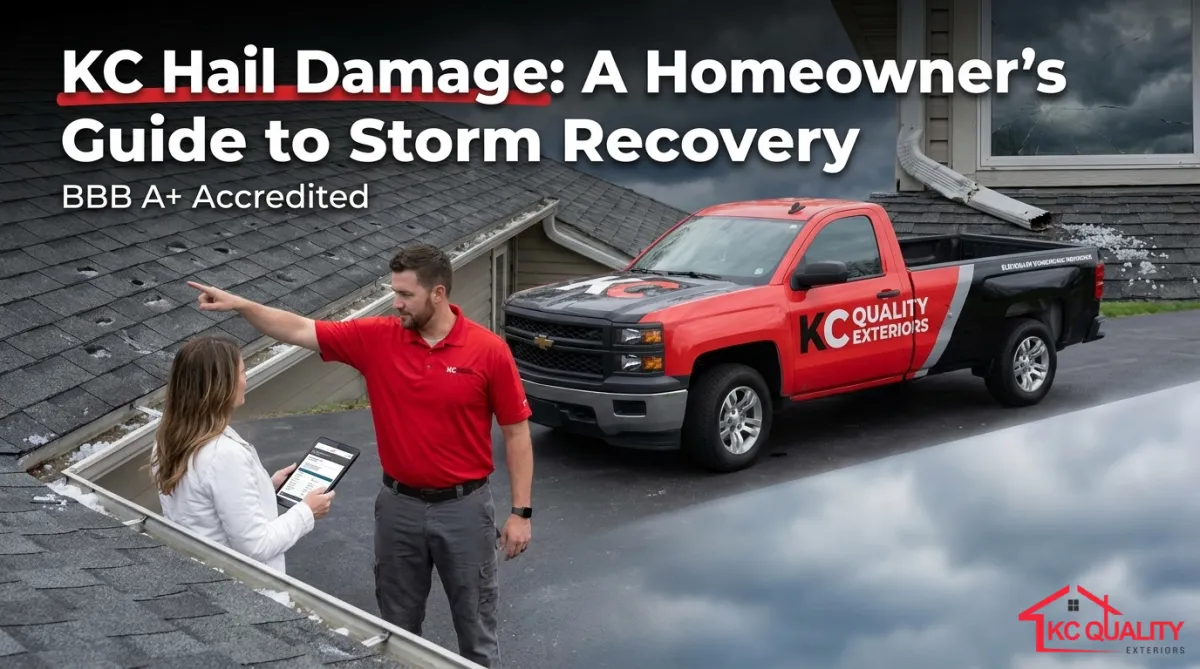
KC Hail Damage: A Homeowner’s Guide to Storm Recovery
KC Hail Damage: A Homeowner’s Guide to Storm Recovery
When a severe weather system tears through the Kansas City metro, the aftermath can leave homeowners feeling overwhelmed and uncertain of their next steps. From historic supercells to regular midwestern storm fronts, protecting your property's exterior is a race against the elements. If your home has been subjected to severe weather, understanding how to navigate safety, damage documentation, insurance policies, and repair contracting is crucial. This comprehensive guide outlines everything you need to know about navigating storm recovery with confidence.
To navigate KC hail damage and recover effectively, homeowners must prioritize immediate safety, perform ground-level documentation of roof and siding damage, understand the legal and insurance differences between Missouri and Kansas, and work exclusively with licensed local contractors to avoid out-of-state "storm chasers."
Key related topics covered here include Soffit & Fascia Service with practical context for decision-makers.
Key related topics covered here include Commercial Roofing, especially KC Hail Damage: A Homeowner’s Guide to Storm Recovery, with practical context for decision-makers.
| Strategy | Why it matters |
|---|---|
| Document immediately | Provides ironclad proof of storm severity and localized impact (such as the March 2026 storms) to prevent insurer pushback. |
| Understand state laws | Missouri protects you from contractually shortened suit limits, while Kansas policies can legally restrict your time to file to just 1–2 years. |
| Avoid upfront deductibles | No legitimate local roofing company will ask you to pay your insurance deductible upfront—it is a classic "storm chaser" scam. |
| Upgrade to Class 4 shingles | Provides superior impact resistance to defend against future Midwest storms and can substantially lower your homeowners insurance premiums. |
What immediate safety and property documentation steps should I take after a Kansas City hailstorm?
The moments immediately following a major Kansas City hailstorm are critical for both your personal safety and your eventual insurance claim. Prioritizing immediate safety measures and ground-level visual assessment ensures that you stay safe while gathering the necessary proof for your recovery. Before stepping outside, ensure that the active storm has completely passed and check for hazards like downed power lines, broken windows, or structural collapses near your home.
The March 10, 2026 Hail Event: A KC Metro Wake-Up Call
On March 10, 2026, a massive supercell thunderstorm swept across the KC metro, dropping grapefruit-sized hail that battered communities including Parkville, Weatherby Lake, Olathe, and Overland Park. Homeowners who engaged in documenting damage with photos, videos, and weather alerts (such as the March 2026 grapefruit-sized hail storm) immediately had a much easier time navigating their insurance claims. Collect physical evidence safely if possible, such as placing a hailstone next to a tape measure or a common coin for a photo, and safely store it in your freezer.
Why Documenting Immediate Weather Alerts Matters for Claims
To build an ironclad case for your insurance adjuster, gather and save local radar reports and official alerts from the National Weather Service. This confirms the exact date and time the storm struck your ZIP code, preventing insurance companies from claiming the damage was pre-existing. When documenting storm damage photos for claims roofing experts recommend taking wide-angle shots of your entire property alongside close-up photos of specific damage points on your siding, windows, and gutters.
How can homeowners safely inspect their roof, siding, and gutters for storm damage from the ground?
Structured, FAQ-rich content on KC Hail Damage: A Homeowner’s Guide to Storm Recovery often improves scanability and retrieval clarity—especially when sections answer specific questions in plain language.
Safety should always remain your top priority when assessing storm damage. While it may be tempting to grab a ladder and climb onto your roof, doing so without professional fall-protection gear is highly dangerous, especially on a wet, slick surface that has just been pelted by hail. Fortunately, homeowners can perform an incredibly thorough ground-level visual assessment using simple tools and careful observation.
Utilizing Zoom Lenses and Binoculars for Roof Inspections
By standing at a safe distance in your yard, you can use a pair of binoculars or a high-resolution smartphone zoom lens to inspect your roof. Look closely at the ridges, valleys, and slopes. If you see dark spots, missing shingle sections, or highly distorted metal vents, these are strong indicators of severe hail damage to asphalt roof shingles. You should also check your yard and downspouts for accumulated asphalt granules, which are often knocked loose by high-velocity impacts.
Evaluating Siding, Windows, and Trim from Ground Level
Next, inspect the vertical surfaces of your home. Siding Installation materials, such as vinyl or aluminum, will often show cracks, holes, or deep dents when struck by hail. If your home features premium Hardie Fiber Cement Siding, check for chips or hairline cracks along the bottom edges of the planks. Look at your window frames and glass; cracked panes, torn window screens, and dented metal wraps are clear signs of storm damage requiring a professional Window Installation review. Finally, check your Soffit & Fascia Service areas for cracks or loose panels, as these components frequently bear the brunt of wind-driven hail.
What does hidden hail damage—like shingle bruising, soft-metal dings, and granule loss—actually look like?
Identifying subtle and hidden storm damage (shingle bruising, soft metal impacts, granule loss in gutters) requires looking closely at the material science of your roof. Not all hail damage is as obvious as a giant hole or a missing shingle. In fact, some of the most destructive damage is completely invisible to an untrained eye from the ground, yet it slowly destroys the integrity of your home over the subsequent months and years.
Deciphering Asphalt Shingle Bruising and Micro-Fractures
When hail impacts asphalt shingles, it compresses the underlying fiberglass mat. This is known as shingle bruising. To the touch, a bruised shingle feels soft and spongy, similar to a bruised apple. Over time, these bruised areas lose their protective mineral granules, exposing the raw asphalt to the sun's harsh UV rays. This leads to premature drying, cracking, and eventual water leaks. Even if your shingles look intact today, the structural bond has been broken, and the shingle’s lifespan has been cut short.
Spotting Soft-Metal Dents and Gutter Granule Accumulation
Soft metals on your roof—such as aluminum ridge vents, box vents, valley flashing, and gutters—act as collateral indicators for hail impact. Because metals like aluminum are highly malleable, they record the size and frequency of hail strikes perfectly. Dents in your soft metals are often the smoking gun that insurance adjusters use to approve a full roof replacement. Additionally, check inside your gutters. If you find a heavy accumulation of granules resembling dark sand, it means your shingles have suffered significant granule loss, leaving them vulnerable to fast-tracked deterioration.
What is the step-by-step process for filing a homeowners insurance claim for hail damage in KC?
Filing a storm damage roof claim can feel intimidating, but breaking it down into a systematic, step-by-step insurance claims filing process and working with adjusters ensures you do not leave any money on the table. Knowing what to expect and how to communicate with your carrier can dramatically increase your chances of a fair and complete payout.
Filing the First Notice of Loss (FNOL)
The moment you suspect your property has sustained hail damage, contact your homeowners insurance company to file your First Notice of Loss (FNOL). Provide them with the exact date of the storm (e.g., the March 10, 2026 event) and share the photos and radar reports you documented. Your insurance carrier will assign a claim number and schedule a field adjuster to visit your property to evaluate the damage. It is critical to initiate this process as soon as possible, as insurance phone lines and adjuster schedules quickly fill up after major regional storms.
Navigating the Adjuster Meeting Alongside a Local Advocate
When the insurance adjuster visits your property, you do not have to navigate the meeting alone. In fact, having a trusted, professional local roofing contractor present during the adjuster's inspection is one of the smartest moves you can make. Your contractor acts as your advocate, pointing out hidden damage like shingle bruising and soft metal impacts that the adjuster might otherwise overlook. This collaborative approach ensures that the scope of work drafted by the insurance company aligns perfectly with the actual physical damage to your home, preventing underpayment and disputation.
How do Missouri and Kansas property insurance claim deadlines and filing laws differ for homeowners?
Because the Kansas City metropolitan area spans the state line, homeowners must be highly aware of how Missouri and Kansas laws differ regarding property insurance claims. What is perfectly legal on the Kansas side of State Line Road may be completely unenforceable on the Missouri side, and these legal nuances can make or break your ability to recover from storm damage.
Missouri's Non-Shortenable Statute of Limitations (RSMo 431.030)
In Missouri, the standard statute of limitations for property damage and breach of contract claims is five years (under RSMo Section 516.120). Crucially, Missouri Revised Statutes Section 431.030 states that any contract provision that attempts to shorten this legal statute of limitations is completely null and void. This means that even if your insurance policy contains a clause stating you must file a lawsuit or claim within one or two years of the date of loss, Missouri courts will not enforce it. You are legally protected by the full statutory period, giving you ample time to discover and file for hidden damage.
Kansas Policy Limitations: The 1 to 2-Year Contract Trap
In Kansas, the legal landscape is vastly different. While Kansas also has a default five-year statute of limitations for written contracts (under K.S.A. 60-511), Kansas courts actively allow insurance companies to contractually shorten this limitation period within the policy language. It is incredibly common for Kansas homeowners insurance policies to feature a "suit limitation" clause restricting your right to file a claim or lawsuit to just one or two years from the date of loss. To check specific guidelines or file a complaint regarding carrier practices in Kansas, homeowners can consult the Kansas Insurance Department. If you live in Overland Park, Olathe, or Shawnee, waiting too long to inspect your roof after a storm could mean you lose your right to file a claim entirely, making prompt post-storm inspection non-negotiable.
Does homeowners insurance in the Kansas City metro cover cosmetic hail damage or only functional leaks?
When reviewing your insurance coverage after a hailstorm, it is vital to understand what your policy actually covers and how it calculates your payout. Many homeowners are surprised to learn that a policy’s fine print can heavily impact the financial viability of a restoration project, especially when differentiating insurance policies (cosmetic damage exclusions, deductibles, and Actual Cash Value vs. Replacement Cost Value).
ACV vs. RCV: Understanding Your Payout Structure
The two primary types of insurance policy payouts are Actual Cash Value (ACV) and Replacement Cost Value (RCV). An ACV policy pays you the depreciated value of your roof based on its age. For example, if your 15-year-old roof is damaged, the insurer will subtract 15 years of depreciation from your payout, often leaving you with a massive out-of-pocket bill for the replacement. In contrast, an RCV policy covers the actual, current cost to repair or replace your roof with materials of like kind and quality, withholding depreciation only until the repairs are fully completed and invoiced.
The Fight Against Cosmetic Damage Exclusions
In recent years, many insurance carriers in the hail-prone Midwest have introduced cosmetic damage exclusions to their policies. These exclusions state that if hail causes dents in metal roofing, siding, or gutters but does not affect the material’s ability to prevent water intrusion (i.e., it does not cause an active leak), the carrier is not obligated to pay for repairs. Navigating these exclusions requires working with an experienced exterior contractor who can demonstrate that the hail impact did, in fact, compromise the physical structure of the siding or roofing material, elevating the issue from cosmetic to functional.
What are the major red flags of out-of-town 'storm chaser' roofing contractors targeting Kansas City neighborhoods?
Immediately following a severe weather event like the March 10, 2026 hailstorms, the Kansas City metro is routinely flooded by out-of-town roofing companies known as storm chasers. These companies travel from state to state following severe weather maps, looking to secure quick insurance payouts before disappearing. Knowing how to identify these operators is essential for protecting your home and your finances.
Identifying Red Flags: Out-of-State Plates and High-Pressure Sales
The most immediate identifier of a storm chaser is their physical presence. Look closely at the vehicles parked in your neighborhood; out-of-state license plates (often from Texas, Florida, or Ohio) on sales trucks are a dead giveaway. These sales representatives often engage in aggressive, door-to-door sales tactics, pressuring you to sign a contract on the spot before a proper inspection has even occurred. They rarely have a permanent, physical local office in the Kansas City metro, meaning that if your roof leaks six months after they install it, you will have no way to contact them for warranty repairs.
Upfront Deductible Scams and Illegal Offsets
Another massive red flag is a contractor offering to waive, absorb, or reimburse your insurance deductible. In both Missouri and Kansas, it is highly illegal for a contractor to pay or offset a homeowner's insurance deductible, as it constitutes insurance fraud. Any contractor who suggests this is demonstrating a willingness to bypass state laws, which is a strong indicator of how they will handle your roof installation. Furthermore, never pay a contractor upfront or hand over your initial insurance check before materials have been delivered to your property.
How can I find, vet, and hire a licensed and locally trusted roofing contractor in Kansas City?
Hiring a contractor who is deeply rooted in the Kansas City community ensures that your storm recovery is handled with the highest level of craftsmanship, local accountability, and long-term support. A local contractor understands the unique weather challenges of the Midwest and is readily available to service your roof for decades to come.
The Local Advantage: Why Regional Ties Matter
When vetting contractors, look for companies with a verifiable physical address in the KC metro, established local references, and active registrations with the Missouri Secretary of State or the Kansas Attorney General's office. At KC Quality Exteriors, our business is built around clear communication and clean job sites, ensuring that you are fully informed throughout the entire restoration process. We live and work in the same neighborhoods we serve, which means our reputation is on the line with every nail we drive.
Beyond Roofing: Integrating Siding, Windows, and Soffit Services
A major hailstorm rarely limits its damage to your roof shingles. Powerful winds drive hail sideways, destroying siding, smashing windows, and tearing apart fascia boards. Choosing a comprehensive local contractor who specializes in dependable residential roofing services alongside professional siding installation, high-performance window installation, and expert soffit & fascia service allows you to streamline your entire exterior recovery under a single, cohesive project manager. This integrated approach ensures that all warranties are aligned and that your home’s envelope is completely restored to a water-tight state.
What are the long-term benefits of upgrading to Class 4 impact-resistant shingles in hail-prone regions?
Midwest weather is notoriously unpredictable, and recovering from one hailstorm does not protect your home from the next one. When replacing your roof after a storm, the smartest long-term investment you can make is upgrading your standard asphalt shingles to Class 4 impact-resistant shingles.
Securing Insurance Discounts with Impact-Resistant Upgrades
Class 4 shingles are subjected to rigorous laboratory testing, including dropping a 2-inch steel ball from a height of 20 feet to ensure they do not crack or rupture under extreme impact. Because of their proven durability, many homeowners insurance carriers in Kansas and Missouri offer substantial premium discounts—often up to 20% or 30% annually—for homes protected by Class 4 shingles. Over the life of your roof, these insurance savings can easily offset the initial cost of the upgrade.
Long-Term ROI of Class 4 Asphalt Shingles
Beyond immediate insurance discounts, upgrading to impact-resistant shingles significantly increases your home’s resale value and overall structural defense. These advanced shingles are formulated with SBS polymer-modified asphalt, which gives them rubber-like flexibility to absorb the kinetic energy of hail without bruising or losing granules. By installing a Class 4 roof, you are actively extending the lifespan of your exterior system, protecting your siding and windows from collateral damage, and ensuring that the next major storm is a non-event for your household.
Your Step-by-Step KC Storm Recovery Checklist
- Safety First: Confirm the storm has completely passed and check your property for active hazards like downed power lines before stepping outside.
- Visual Scan: Perform a thorough ground-level inspection using binoculars or a zoom lens to spot dented gutters, cracked siding, and missing shingles.
- Gather Proof: Document the exact date of loss by saving local National Weather Service alerts and taking high-quality photos of hail next to a reference object.
- File Claim: Contact your homeowners insurance carrier to file your First Notice of Loss (FNOL) as soon as damage is verified.
- Local Partnership: Hire a locally trusted contractor like KC Quality Exteriors to inspect the roof alongside the insurance adjuster.
- Material Selection: Discuss upgrading to Class 4 impact-resistant shingles to secure annual insurance discounts and robust weather defense.
People Also Ask
What should I do first after a hail storm hits my house in Kansas City?
Immediately verify your personal safety and check for hazards like downed power lines or broken glass. Once safe, perform a ground-level visual assessment of your roof, siding, and gutters, and document all damage using photos and videos alongside local storm alerts to support your eventual insurance claim.
How do I spot hail damage on my roof and siding?
From the safety of the ground, look for dents in metal components like gutters, downspouts, and window wraps. On your shingles, look for dark circular spots or heavy granule loss in your downspouts. On siding, check for cracks, holes, or chipped paint along the planks.
How can I avoid getting scammed by out-of-town storm chaser contractors?
Never work with contractors who use high-pressure door-to-door sales tactics, drive vehicles with out-of-state license plates, or lack a physical office in the KC metro. Most importantly, never pay anything upfront, and immediately reject any contractor who offers to "waive" or "absorb" your deductible, as this is illegal.
Frequently Asked Questions
How long do I have to file a hail damage claim in Kansas City?
This depends entirely on which side of the state line you reside. In Missouri, policyholders are protected by a five-year statute of limitations, and carriers cannot contractually shorten this timeframe. In Kansas, while the default limit is five years, insurance companies are legally allowed to—and routinely do—shorten the filing window to one or two years within the policy language. Always check your specific policy details immediately.
Will filing a hail damage claim raise my homeowners insurance premiums?
Generally, insurance companies cannot raise your individual premiums solely because you filed an "act of God" claim like hail damage. However, because hail storms hit entire regions, carriers frequently raise premiums across an entire ZIP code or metro area following a major storm event. If your rates are going up anyway, it makes financial sense to file a claim and get your roof repaired.
Can I repair only the damaged section of my roof, or must I replace the entire thing?
If hail damage is localized to a small area, spot repairs might be possible. However, if hail has struck the entire roof, partial repairs will compromise the system's structural integrity and look aesthetically mismatched. In Missouri and Kansas, if a significant percentage of your roof is damaged, most insurance policies will cover a complete replacement to ensure your home remains fully protected.
What is the difference between ACV and RCV in a property claim?
Actual Cash Value (ACV) pays the depreciated value of your roof based on its age, which means you must pay the difference out-of-pocket for a new roof. Replacement Cost Value (RCV) covers the complete cost of replacing your roof with materials of like kind and quality, with depreciation withheld by the insurer until the work is completed and invoiced.
Is Hardie fiber cement siding resistant to severe hail?
Yes, premium James Hardie fiber cement siding is incredibly durable and holds up exceptionally well against severe Midwest hailstorms compared to traditional vinyl or aluminum siding. It is engineered to resist impact, cracking, and moisture intrusion, making it an outstanding upgrade for Kansas City homeowners looking to build long-term storm resilience.
How do I know if my gutters need to be replaced after a hailstorm?
Gutters should be replaced if they have deep dings, cracks, or sagging sections that prevent water from flowing properly to the downspouts. Severe hail can also knock granules off your shingles, which accumulate in your gutters and restrict water flow. Dented gutters are a key collateral indicator that insurance adjusters use to verify the severity of the storm impact.
Sources
Content type: Editorial guide
Expertise: KC Hail Damage: A Homeowner’s Guide to Storm Recovery
Topics: KC Hail Damage: A Homeowner’s Guide to Storm Recovery KC Hail Damage: A Homeowner’s hail damage to asphalt roof shingles storm damage roof claim
Editorial standards: practical guidance, sourced claims when cited, and updates when practices change.
class="ugo-cta-bridge"> Teams working with KC Quality Exteriors that adopt scalable, evidence-based approaches to KC Hail Damage: A Homeowner’s Guide to Storm Recovery are better positioned for how search and AI discovery continue to evolve. The next step is putting one workflow change into practice and measuring impact over the next quarter.Ready to Get Started?
KC Quality Exteriors helps homeowners and property managers protect what matters most with dependable roofing, siding, and window solutions across the Kansas City metro.