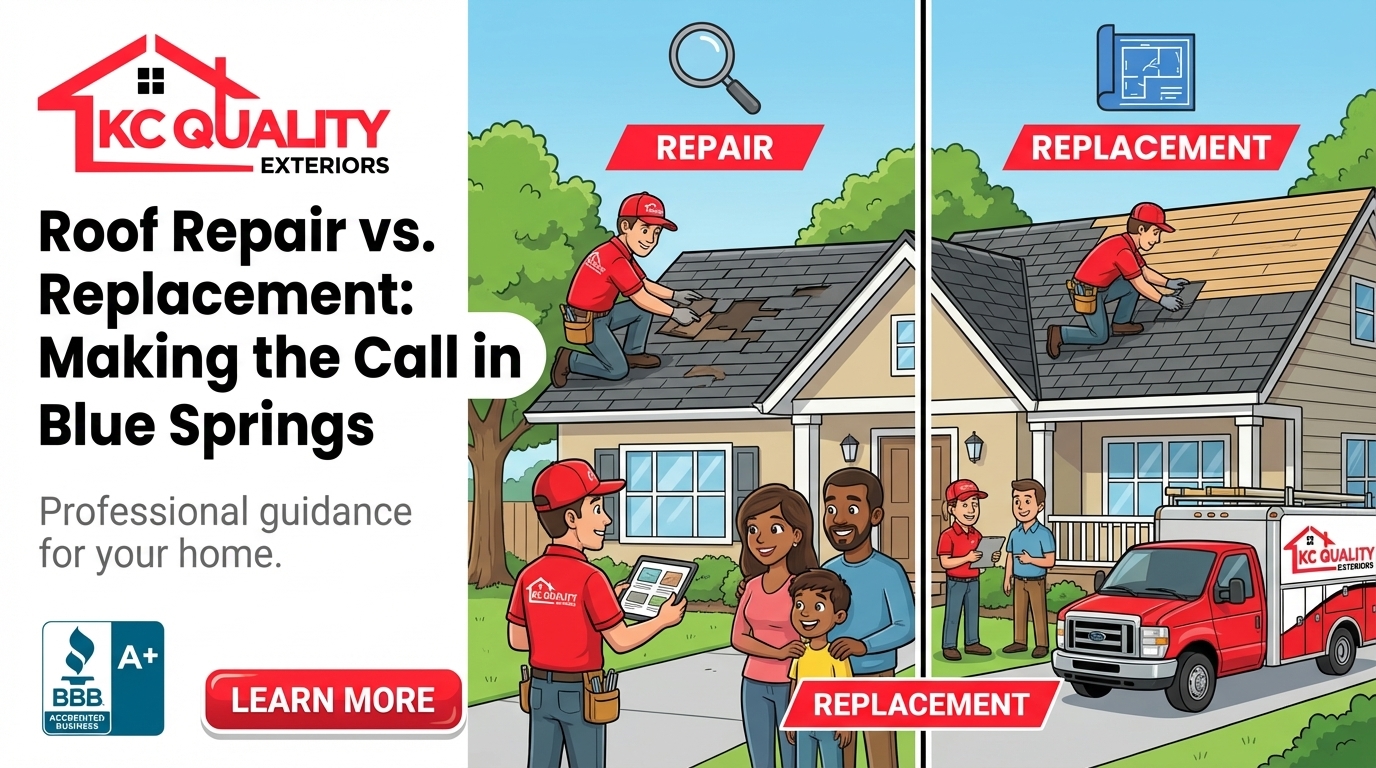
Roof Repair vs. Replacement: Making the Call in Blue Springs
For many homeowners in Blue Springs, the roof is an out-of-sight, out-of-mind component of the house—until a water stain appears on the ceiling or a severe Missouri thunderstorm rolls through Jackson County. When damage occurs, the immediate question is always the same: Do I just need a quick repair, or am I looking at a full roof replacement? This decision isn't just about immediate costs; it’s about protecting your largest investment and ensuring your family stays dry during our unpredictable midwestern seasons.
To determine if you need a roof repair or replacement in Blue Springs, consider the roof's age and the extent of the damage. Generally, if the damage is localized to a small area and the roof is under 15 years old, a repair is sufficient. However, if over 25% of the roof is damaged or the shingles are over 20 years old, a full replacement is usually the most cost-effective long-term solution.
1. The Homeowner's Dilemma: Repair or Replace Your Blue Springs Roof?
The dilemma of choosing between a repair and a replacement often stems from a lack of clear information. In Blue Springs, where we experience everything from high-speed winds to heavy snow loads, a roof’s integrity can change overnight. Homeowners often worry that a contractor will push for a full replacement when a simple fix would suffice, or conversely, that a "patch job" will only delay the inevitable and lead to more expensive structural damage down the road. This is why a "heart of a teacher" approach is vital—you need to understand the why behind the recommendation.
At KC Quality Exteriors, we believe in transparency. A minor leak near a chimney or a few missing shingles after a windy day at Landahl Park doesn’t always signal the end of your roof’s lifespan. However, ignoring the cumulative effects of Missouri’s freeze-thaw cycles can turn a minor repair into a major replacement project. The goal of this guide is to empower you with the knowledge to look at your roof like a professional would, evaluating the short-term savings of a repair against the long-term security of a new installation.
Understanding the Scope of Damage
The first step in making the call is assessing the scope. Is the damage localized or widespread? If you can point to one specific spot where a tree limb fell or where a leak is occurring, you’re likely in the territory of a targeted repair. Localized damage is often structural or related to specific components like flashing or boots, rather than the shingles themselves. This type of damage is common in newer Blue Springs developments where the roofing materials are still within their peak performance years.
Widespread damage, on the other hand, is usually systemic. This includes things like granule loss across the entire roof surface, curling shingles on every slope, or multiple leaks in different rooms. In these cases, repairing one spot is like putting a bandage on a sinking ship. When the protective layers of the shingles have reached their limit across the entire surface, the only way to restore the home's protective envelope is a full replacement.
2. Roof Repair: When a Targeted Fix is the Smart Move
Roof repairs are the primary defense against premature roof failure. When caught early, minor issues can be addressed for a fraction of the cost of a new roof. In the Blue Springs area, we often see roofs that are perfectly healthy except for one or two vulnerable points. For example, if your roof is only 10 years old and you discover a leak around a vent pipe, a simple boot replacement can extend the life of that roof for another decade. Repairs are about precision and maintenance.
Common Scenarios for Repair
- Missing Shingles: If a localized wind gust (common near the open fields of Jackson County) peels away a few shingles, they can often be replaced individually to match the existing roof.
- Damaged Flashing: The metal transitions around chimneys, dormers, and valleys are common leak points. Replacing the flashing is a standard repair that doesn't require a whole new roof.
- Minor Leaks: If a leak is caught immediately after a storm and hasn't caused widespread rotting of the roof deck (sheathing), a targeted fix is usually the best route.
- Gutter Maintenance Issues: Sometimes, what looks like a roof leak is actually a gutter backup. Cleaning and securing gutters can resolve these issues without touching the shingles.
The key to successful repairs is matching the existing materials. This can be challenging for older roofs where the shingle color has faded or the specific line has been discontinued. A professional contractor should provide a sample match to ensure that your repair doesn't become an eyesore that hurts your curb appeal. While the functional goal of a repair is to stop water, the aesthetic goal is to make the fix invisible to the naked eye.
3. Roof Replacement: Signs It’s Time to Invest in a New System
There comes a point where continuing to repair an old roof is throwing good money after bad. In Blue Springs, many neighborhoods built in the 1990s and early 2000s—such as those near Woods Chapel Road or Adams Dairy Parkway—are currently hitting the "age wave." This is the period where roofs that were installed 20 to 25 years ago are naturally reaching the end of their functional lifespan. If your neighbors are all getting new roofs, it’s a strong indicator that your roof is likely due for an inspection.
Critical Warning Signs
One of the most obvious signs that you need a replacement is the presence of "bald spots" on your shingles. Asphalt shingles are coated with ceramic granules that protect the underlying bitumen from UV rays. As a roof ages, these granules loosen and wash into your gutters. If you see piles of sand-like material at the base of your downspouts, your shingles are losing their armor. Without granules, the shingles will quickly become brittle, crack, and leak.
Another red flag is the "shingle curl." Look up at your roof during the early morning or late evening when the shadows are long. If the edges of the shingles are turning upward (cupping) or the middles are bulging (clawing), the shingles are no longer shedding water effectively. This physical deformation is a sign that the shingles have dried out and are prone to being blown off by the next high wind event. When curling is visible across multiple slopes, a repair will no longer suffice.
Structural Issues and Sagging
Perhaps the most urgent sign for a replacement is a sagging roofline. This indicates that water has likely bypassed the shingles and underlayment, soaking the wooden decking below. Over time, this moisture causes the wood to rot and lose its structural integrity. A sagging roof is a safety hazard and often requires not just new shingles, but new plywood decking as well. If you notice any dipping or swaying in the lines of your roof, you should contact a professional immediately to prevent a potential collapse.
4. The 'Big Three' Decision Factors: Age, Scope, and Cost
When we help Blue Springs homeowners make this decision, we look at the "Big Three" factors. These provide a logical framework to remove the emotion from the decision and focus on the data. The first factor is Age. Most standard asphalt shingle roofs in Missouri are designed to last 20 to 25 years. If your roof is 18 years or older, any major repair is likely a temporary fix. You are better off putting that money toward a full replacement that comes with a new warranty.
The second factor is Scope. We use the "25% Rule." If the damage covers more than 25% of the total roof area, the labor and material costs to patch it correctly often approach 50% of the cost of a full replacement. At that point, the value proposition shifts heavily toward replacement. You wouldn't pay half the price of a new car just to fix the transmission on a 15-year-old vehicle; the same logic applies to your roofing system.
Comparing Repair vs. Replacement ROI
Factor Repair Replacement Upfront Cost Low ($250 - $3,000) High ($7,000 - $20,000+) Lifespan Extension 1-5 Years 25-50 Years Home Value Impact Minimal / Maintains State High (Approx. 60% ROI) Warranty Protection Workmanship only (usually) Full Manufacturer + WorkmanshipThe third factor is Cost and long-term financial health. While a repair is cheaper today, a new roof can significantly lower your home insurance premiums (especially in Blue Springs, where storm history is a factor) and reduce monthly energy bills through better ventilation and heat reflection. When you factor in these savings, the true cost of a replacement is often lower than it appears on the initial estimate.
5. Blue Springs Climate Watch: How Missouri Storms Dictate Your Roofing Needs
Our local weather in Blue Springs is notoriously hard on roofing materials. We aren't just dealing with rain; we are dealing with high-velocity straight-line winds, heavy hail, and the brutal "freeze-thaw" cycle. During a typical Jackson County winter, water can seep into small cracks in your shingles or flashing during a sunny afternoon, only to freeze and expand when the temperature drops at night. This expansion acts like a slow-motion crowbar, widening gaps and creating leaks where there were none before.
The Impact of Hail and Wind
Hail is a major driver of roof replacements in Blue Springs. Even small hail can bruise the asphalt mat of a shingle, leading to a "latent defect." This means the shingle looks okay from the ground, but the structural integrity is compromised, and it will fail prematurely. Wind is equally destructive. Because Blue Springs has many elevated areas and open spaces, wind can get under the "tabs" of older shingles that have lost their adhesive seal, folding them back or snapping them off entirely.
When evaluating whether to repair or replace after a storm, we often look at the density of hail hits. If there are 10 or more hits within a 10x10 square (called a "square" in roofing terms) on multiple slopes, most insurance companies will deem the roof a total loss. In this scenario, repair is not even an option because the entire surface has been structurally compromised. Understanding these local weather patterns helps homeowners realize that a new roof isn't just a cosmetic upgrade—it's a necessary response to a harsh environment.
6. Cost Breakdown: What to Expect for Roofing Projects in Jackson County
Talking about money is where transparency matters most. In Blue Springs, roofing costs are influenced by material prices, labor availability, and the complexity of the roof (the pitch and number of valleys). For a standard repair—such as replacing a pipe boot or a single square of shingles—you can expect to pay anywhere from $250 to $1,000. More complex repairs involving chimney flashing or structural repair of the decking can range from $1,500 to $3,000.
Typical Replacement Price Ranges
For a full roof replacement on a typical 2,000-square-foot home in Blue Springs, the investment usually falls between $8,000 and $16,000 for architectural asphalt shingles. If you opt for premium materials like metal or impact-resistant shingles, that cost can rise to $20,000 or more. While these numbers can seem daunting, it is important to remember that a new roof is one of the few home improvements with a consistently high return on investment (ROI). According to regional data, homeowners often recoup 60-70% of the roof's cost in added home value immediately.
Local financing options can also make a replacement more accessible. Many Blue Springs residents take advantage of Missouri-specific energy-efficiency incentives or flexible payment plans offered by local contractors. At KC Quality Exteriors, we work to provide detailed, line-item estimates so you know exactly where every dollar is going—from the permit fees to the disposal of the old shingles.
7. Navigating Blue Springs Building Codes and HOA Requirements
One factor that many national roofing blogs miss is the impact of local regulations. The City of Blue Springs has specific building codes that must be followed. For instance, the city requires a building permit for all roof replacements. This permit ensures that a city inspector will review the work to confirm it meets safety standards, such as proper ice and water shield installation in the valleys—a critical requirement for our Missouri winters.
HOA Compliance and Material Standards
Beyond city codes, many Blue Springs neighborhoods (like Blue Springs South or Chapel Hill) are governed by Homeowners Associations (HOAs). These HOAs often have strict rules about the type of roofing materials allowed and even the specific colors you can choose. We have seen cases where homeowners repaired their roof with shingles that didn't match the HOA-mandated color, leading to fines and the eventual need to redo the work. Before making the call to repair or replace, it is vital to check your HOA bylaws or work with a contractor who is familiar with local neighborhood requirements.
Another important local code is the "two-layer rule." In Missouri, building codes generally allow for a maximum of two layers of shingles on a roof. If your home already has two layers and you experience damage, a repair is often impossible because the underlying structure is obscured. In this case, a full "tear-off" replacement is legally required to bring the home up to code. We always recommend a full tear-off regardless of the number of layers, as it's the only way to inspect the decking for hidden rot.
8. The Insurance Process: Handling Storm Damage Claims in Blue Springs
If your roof damage was caused by a specific event like a hail storm or a fallen tree, your homeowner's insurance may cover the cost of repair or replacement. However, navigating the insurance world in Blue Springs can be tricky. Insurance companies differentiate between "Actual Cash Value" (ACV) and "Replacement Cost Value" (RCV) policies. With an ACV policy, the insurer will subtract depreciation based on the age of your roof, which can leave you with a significant out-of-pocket expense for a full replacement.
Working with Your Adjuster
When an insurance adjuster visits your Blue Springs home, their job is to look for evidence of storm damage. It is highly beneficial to have your roofing contractor present during this inspection. A professional contractor can point out subtle signs of damage that an adjuster might miss, such as micro-cracking from hail or wind-damaged seals. This ensures you get a fair assessment and that the insurance payout actually covers the necessary repairs or replacement.
Be wary of "storm chasers"—out-of-state contractors who descend on Blue Springs after a big storm. These companies often push for quick insurance claims and then disappear, leaving you with no local support if the roof leaks a year later. Choosing a local company like KC Quality Exteriors ensures that we are here to handle the supplements and paperwork required by your insurance company to get the job done right.
9. Long-Term Value: Energy Efficiency and Impact-Resistant Shingles
If you decide on a replacement, you have the opportunity to upgrade your home’s performance. Modern roofing technology has come a long way since your original roof was likely installed. One of the best investments for a Blue Springs homeowner is Class 4 Impact-Resistant Shingles. These shingles are designed to withstand larger hail without cracking or losing granules. While they cost slightly more upfront, many insurance providers in Jackson County offer significant annual premium discounts for homes with Class 4 roofs.
Energy Efficiency and Ventilation
A full replacement also allows you to address attic ventilation. Many older homes in the Blue Springs area have inadequate venting, which leads to heat buildup in the summer and ice dams in the winter. By installing ridge vents and ensuring proper intake at the soffits, you can lower your AC bills and prevent the shingles from "cooking" from the inside out. This holistic approach to the roofing system is something a simple repair cannot offer.
Furthermore, there are often federal or state tax credits available for installing Energy Star-certified roofing materials. These "cool roofs" reflect more sunlight and absorb less heat, which is a massive benefit during our humid Missouri July and August. When you calculate the insurance discounts, energy savings, and tax credits, the "true cost" of a replacement often becomes much more manageable compared to the endless cycle of repairing an obsolete system.
10. Making the Call: Why a Local Professional Inspection is Your Best First Step
At the end of the day, you shouldn't have to guess whether you need a repair or a replacement. The most important step any Blue Springs homeowner can take is scheduling a professional, no-obligation inspection. A local expert who knows the specific challenges of our climate can provide a detailed report, complete with photos of your roof's condition. This allows you to see what they see—whether it’s a simple loose flashing or a systemic failure of the shingle mat.
At KC Quality Exteriors, our philosophy is simple: we treat your home like it’s our own. If a repair is all you need to get another five years out of your roof, that’s exactly what we will recommend. If a replacement is necessary for the safety and value of your home, we will explain why and walk you through every option available. We believe that clear communication and education are the foundations of a job well done. Don't wait for the next big storm to find out where your roof stands. Take the proactive step of getting an expert opinion today.
Ready to Get Started?
KC Quality Exteriors helps homeowners and property managers protect what matters most with dependable roofing, siding, and window solutions across the Kansas City metro.
Visit Our Homepage